Published by Yale University Press
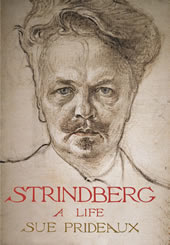
While Sue Prideaux was writing Edvard Munch: Behind the Scream she became increasingly fascinated by Munch’s friend August Strindberg. Novelist, satirist, poet, photographer, painter, alchemist and hellraiser, Strindberg is principally known, in Arthur Miller’s words, as ‘the mad inventor of modern theatre’.
In Miss Julie Strindberg wrote the first psychodrama, taking the theatre out of the polite drawing room into the snakepit of psychological warfare. The tale of a servant who seduces the Count’s daughter, Miss Julie is one of the roles great actresses aspire to. Famously she has been played by both Meryl Streep and Helen Mirren. In September 2012, Juliette Binoche will be playing Miss Julie at the Barbican theatre in London (dresses by Lanvin).
In August Strindberg: A Life, Sue Prideaux reveals, for the first time, the real people on whom he based Miss Julie and her servant Jean, the bizarre circumstances in which the play was written and the suicide that served as the model for the play’s shattering ending. Even more than most, Strindberg is a writer whose life sheds invaluable light on his work, which he based unashamedly upon it: ‘I dissect the corpse I know best; learning anatomy, physiology, psychology and history from the carcass.’
Strindberg’s milieu was fin-de-siecle Paris and Berlin, among the post-Darwinians who were questioning the idea that the physical world exhaustively described reality and the self was a mere evolutionary result. He painted and debated with Edvard Munch and Paul Gauguin, shared a wife with Frank Wedekind, corresponded with Nietzsche, flirted with the Paris Occult and studied Charcot, Bernheim and Jeune, the teachers of Freud.
Strindberg is less well known than his two great contemporaries, Ibsen and Chekhov, but his influence is pervasive. Not just Arthur Miller but also Kafka, Eugene O’Neill, Tennessee Williams, Thomas Mann, Friedrich Dürrenmatt and Luigi Pirandello acknowledge their debt to him.
Prideaux’s great talent is to organise Strindberg’s dramatic and chaotic life into a gripping and highly readable narrative. It is a dispassionate book that both illumines Strindberg’s work and restores humour and humanity to a man often shrugged off as too difficult.
See Strindberg’s Bathtub: http://yalebooks.wordpress.com/2012/03/07/strindbergs-bathtub-author-article-by-sue-prideaux/
Strindberg: a Life – winner of the 2012 Duff Cooper Prize for non-fiction, shortlisted for the 2012 Samuel Johnson Prize for non fiction and for the 2012 Sheridan Morley Prize for theatre biography.
REVIEWS:
“What an absolutely extraordinary man August Strindberg was, and what a tormented, demented life he led. I haven’t read such a fascinating biography for ages… You can see how much fun [Sue Prideaux] is having with Strindberg. Anyone reading her marvellous book will have that much fun too.” Sam Leith, The Spectator.
“A rich and absorbing biography…writing the life of a frenzied, unstable genius like Strindberg is an enormous challenge, and Prideaux rises to it with fine authority.” John Carey, The Sunday Times.
“Sue Prideaux has written a lively, enlightening, and at times thrilling life of an extraordinary artist… Prideaux also writes very movingly of the playwright’s last years… she is persuasive in conveying Strindberg’s greatness and the novelty of his achievement.” John Banville, The New York Review of Books.
“An absorbing new study…Prideaux is a deft guide to the absinthe-heavy bohemian underworlds of Berlin and Paris which Strindberg inhabited for much of the 1890s.” Claudia FitzHerbert, Daily Telegraph.
“The best biography I’ve read in ages.” Matthew Sweet, Nightwaves, BBC radio 4.
“A deeply researched and engrossing biography…the copious selection of his elemental canvases and celestographs is one beauty of this outstandingly produced book…Prideaux opens her book with a bravura chapter on the origins of Miss Julie, excels in relating his characters to their living originals, and in showing how they were transformed by the process of post-naturalism.” Irving Wardle, Literary Review.
“Fascinating and beautifully written.” Anthony Beevor, The Sunday Telegraph.
“In Prideaux’s hands, Strindberg, a vulnerable but also naively determined man with striking chaotic hair like a combed back walnut whip, comes vividly to life. Indeed the joy of her book is in the detail, from quoted letters and diaries and some stunning photography.” Tim Auld, The Sunday Telegraph.
“The Strindberg portrayed in this detailed, accessible biography, which coincides with the centenary of his death on 12 May 2012, reveals a man and a writer few in the English speaking world will have the notion of… Sue Prideaux’s lively account of a wilful, passionate, often deranged pilgrimage in search of truth, artistic honest and, finally God, will change our narrow perspective on the astonishing polymath.” Robert Carver, The Tablet.
“An exhaustingly researched biography… and a deft piece of detective work.” David Stenhouse, Scotland on Sunday.
“This unstable genius is brought to book in this fine study.” Sunday Times Culture.
“very readable” The Art Newspaper.